Research
NP Lab at Caltech investigates fundamental quantum electronic phenomena in novel materials and nanoscale devices with potential applications in quantum nanoscience. Our main focus is on devices based on two-dimensional materials only a few atoms thick — promising platforms for studying topological and correlated electronic quantum states. For further information, contact Stevan or explore our publications.
Van der Waals Heterostructures
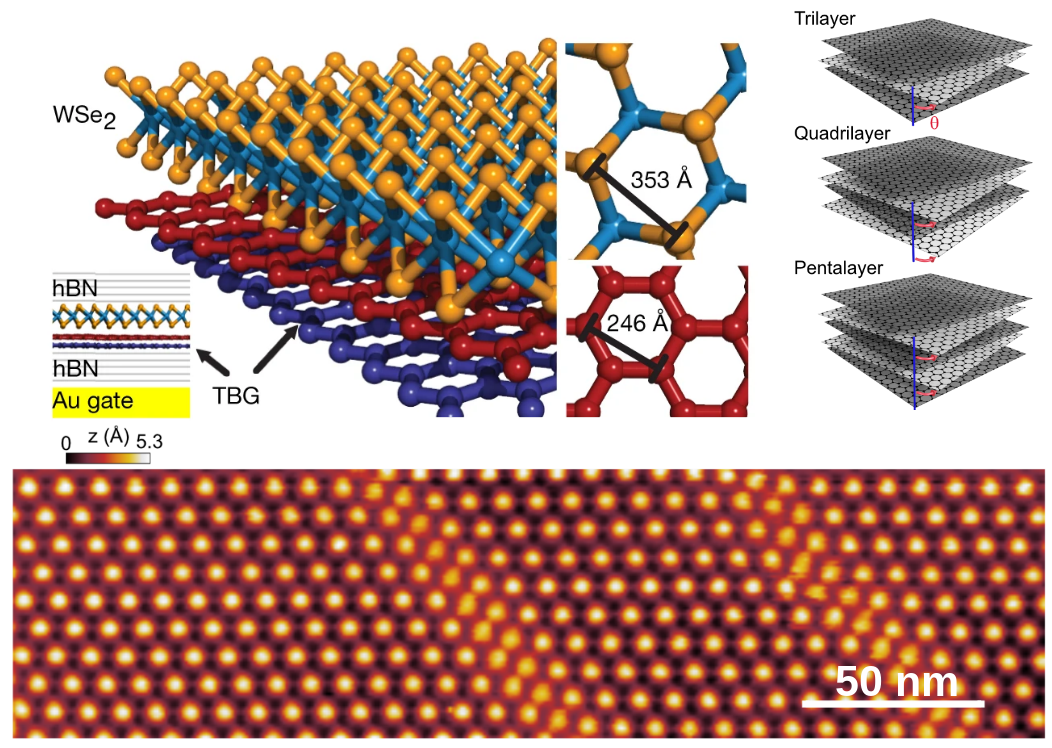
Two-dimensional materials offer unlimited possibilities for designing novel structures to explore electronic correlations and topological phenomena. By stacking atomically thin layers — graphene, hexagonal boron nitride, transition metal dichalcogenides — we create van der Waals heterostructures with precisely controlled properties. Besides their importance in fundamental condensed matter physics, these structures have great potential for future quantum science applications.
Scanning Tunneling Microscopy
Our lab operates millikelvin scanning tunneling microscopes capable of atomic-resolution imaging and spectroscopy at extremely low temperatures. This enables direct visualization of electronic order parameters — charge density waves, pair density modulations, inter-valley coherent order, and nematic states — in two-dimensional quantum materials.
Key publications:
- Resolving intervalley gaps and many-body resonances in moiré superconductors, Nature (2026)
- Cooper-pair density modulation state in an iron-based superconductor, Nature 640, 55–61 (2025)
- Imaging inter-valley coherent order in magic-angle twisted trilayer graphene, Nature 623, 942–948 (2023)
Topological Quantum Matter
Our group has a long-standing interest in topological phases of matter, from topological insulators and crystalline insulators to Majorana fermions in hybrid superconductor-semiconductor systems. Our earlier work on atomic chains on superconductors provided landmark evidence for Majorana modes, and we continue to explore topological phenomena in moiré and van der Waals platforms.
Key publications:
- Correlation-driven topological phases in magic-angle twisted bilayer graphene, Nature 589, 536–541 (2021)
- Observation of Majorana fermions in ferromagnetic atomic chains on a superconductor, Science 346, 602 (2014)
- One-dimensional topological edge states of bismuth bilayers, Nature Physics 10, 664 (2014)